Building date:
Original use: Residence
Corner structures:
Mortar application and content:
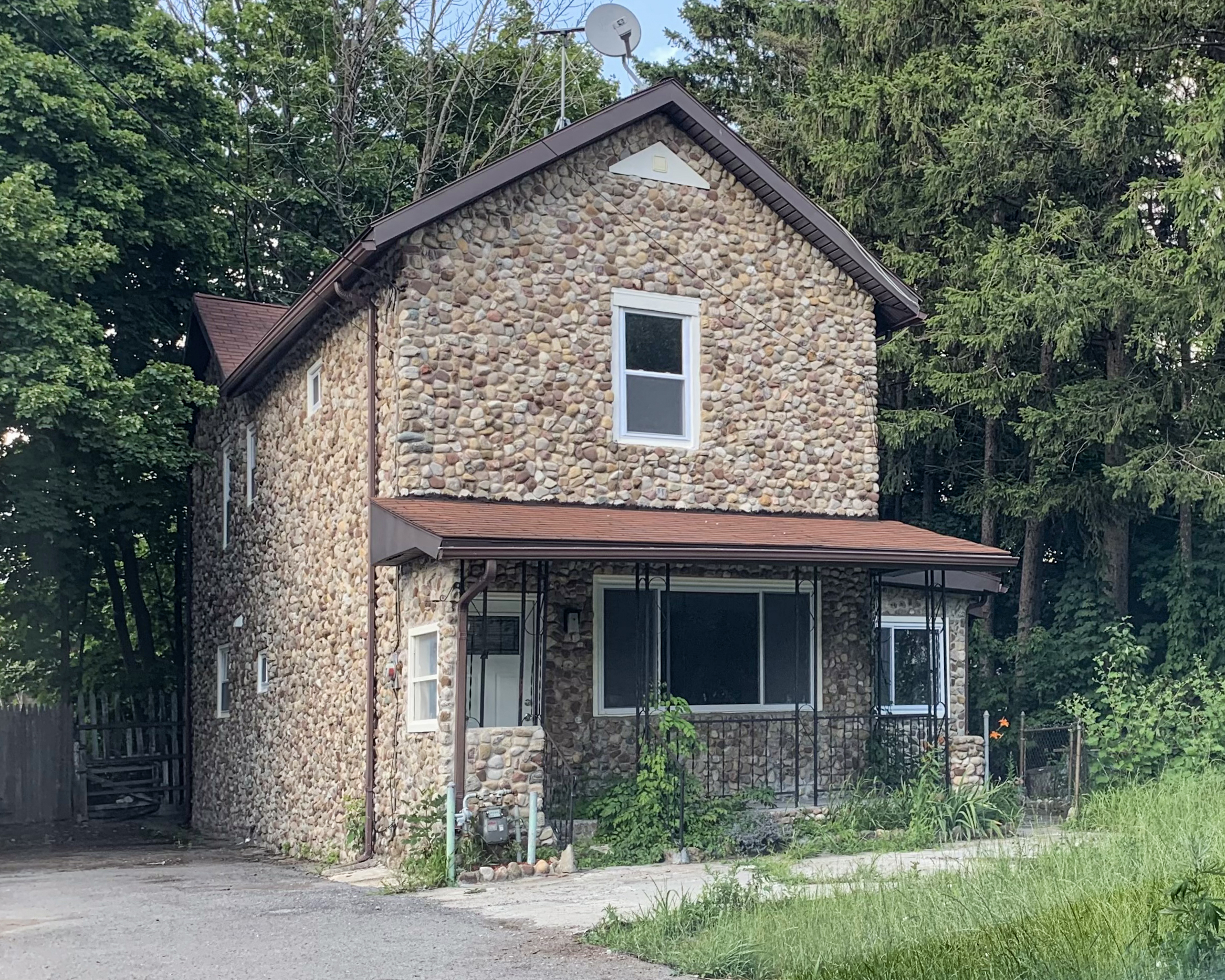
Types and uses of stones: Random application of cobblestones. Faux cobblestone, not an authentic cobblestone structure.
Types and choice of windows:
Structures with similar masonry details:
Masons who worked on building:
Unique features:
Map views courtesy Google Maps. Address is Google Earth confirmed; 42°59'40.21"N 78°11'08.57"W. Current owner of record, Sauers as of the 2024 Tax Roll.
Town of Batavia and Genesee County Maps
Well.... it's certainly distinctive!
Difficult to determine origins of this highly unusual irregular stone cladding - that extends all the way to the ground (foundation isn't visible).
Is this a late 19th-century house whose original siding was wood (clapboard?), and we're looking at a veneer of stone cladding added in early 1900s?
In regards to mortar: looks more 20th century, than what you'd see on a 19th century house. Could be a layman's approach to creating pseudo-cobblestone cladding.
Was this a neighborhood with Italian families? I've seen some distinctive early-20th-century masonry on houses, walls, etc. in the Western New York that were created by masons of Italian birth in the first half of the 20th century. Cynthia Howk, email 8 May 2024.
Bill [Sauers (related to owner)] and I discussed this house and its possible history/evolution to present appearance with veneer of stone-and-mortar cladding. As he's president of the Greece Historical Society, he has experience with searching documents, etc. He's going to look into the history of this area of Batavia, in particular this street, which is adjacent to the railroad tracks.
From what I can tell, this appears to be a house likely built in the early 20th century, probably had some type of wood cladding, and the stone-and-mortar "veneer" now visible was added later - perhaps after WWII.
I took a look at "Thorpe St." and immediate neighborhood, on line, via "street view." Thorpe St. runs north, off Watson St., to a "dead end," where this house - #1 Thorpe St. - is located. The main east-west railroad tracks are located directly behind (to the north of) #1 Thorpe St. & Tonawanda Creek is a short distance to the west. The other houses in this neighborhood are on small lots, closely spaced, and similarly vernacular in appearance. Almost all of them are clad with synthetic siding (mostly vinyl) and enlarged with later additions. It appears to be an area whose residents have been principally working-class and of modest means. Cynthia Howk, email 10 May 2024.
Editor's Note: The structure is not an authentic cobblestone structure, primarily because there are no orderly rows of similar size cobbles. Refer to the "Faux Cobblestone" page for additional examples and discussion. As an educational website, our intent is to provide a thorough understanding of the use of cobble "stones" as materials in the construction and architecture of authentic cobblestone structures, of which, uniquely, no two are exactly alike and vary considerably in their selection of stones as building material and use/application in construction. In reality there is a gray area, a transition from non-authentic to authentic cobblestone structure construction that exists.
 IMG_9821.jpg ¹ | 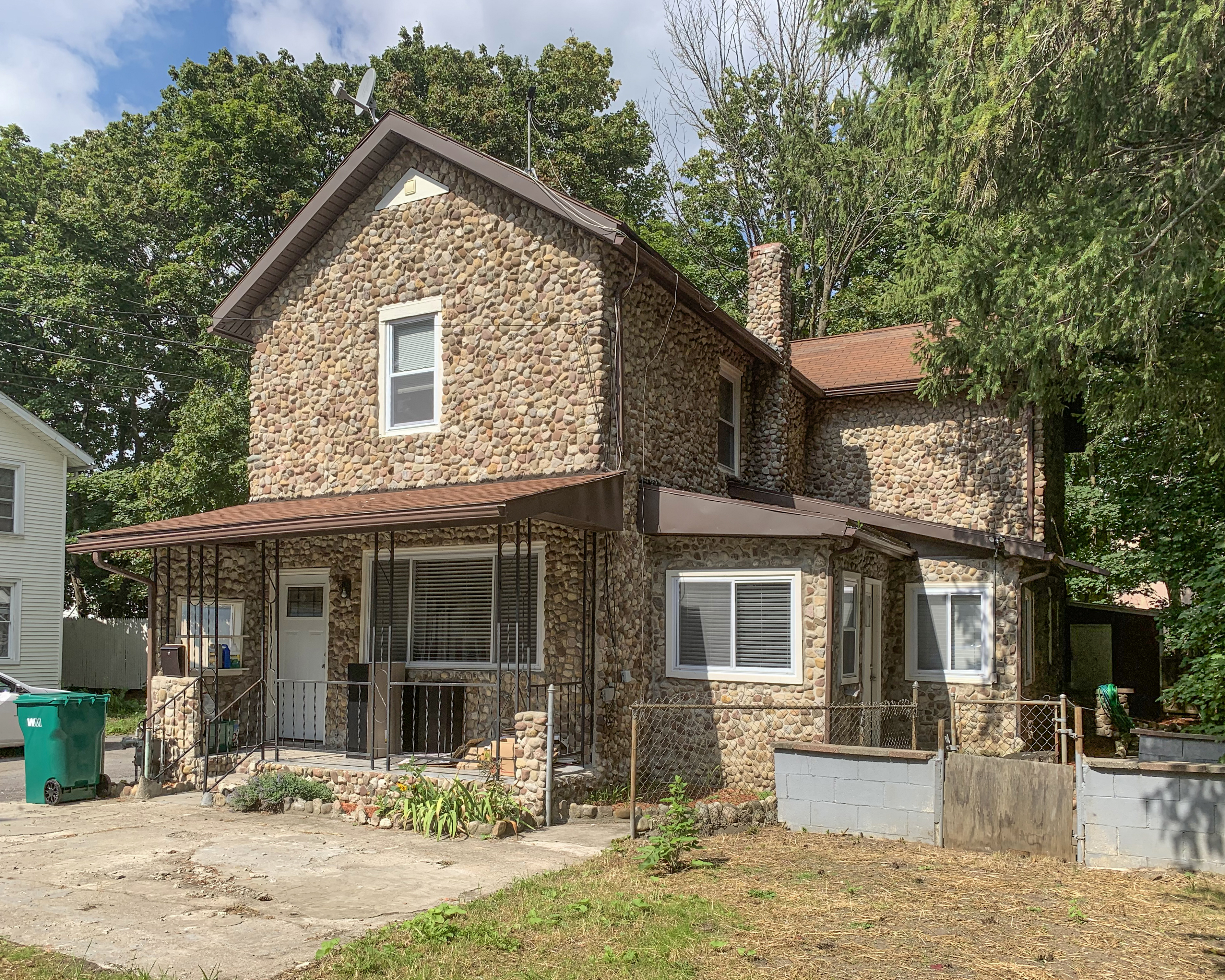 9-18-23 Matt's House in Batavia.jpg ¹ 9-18-23 | 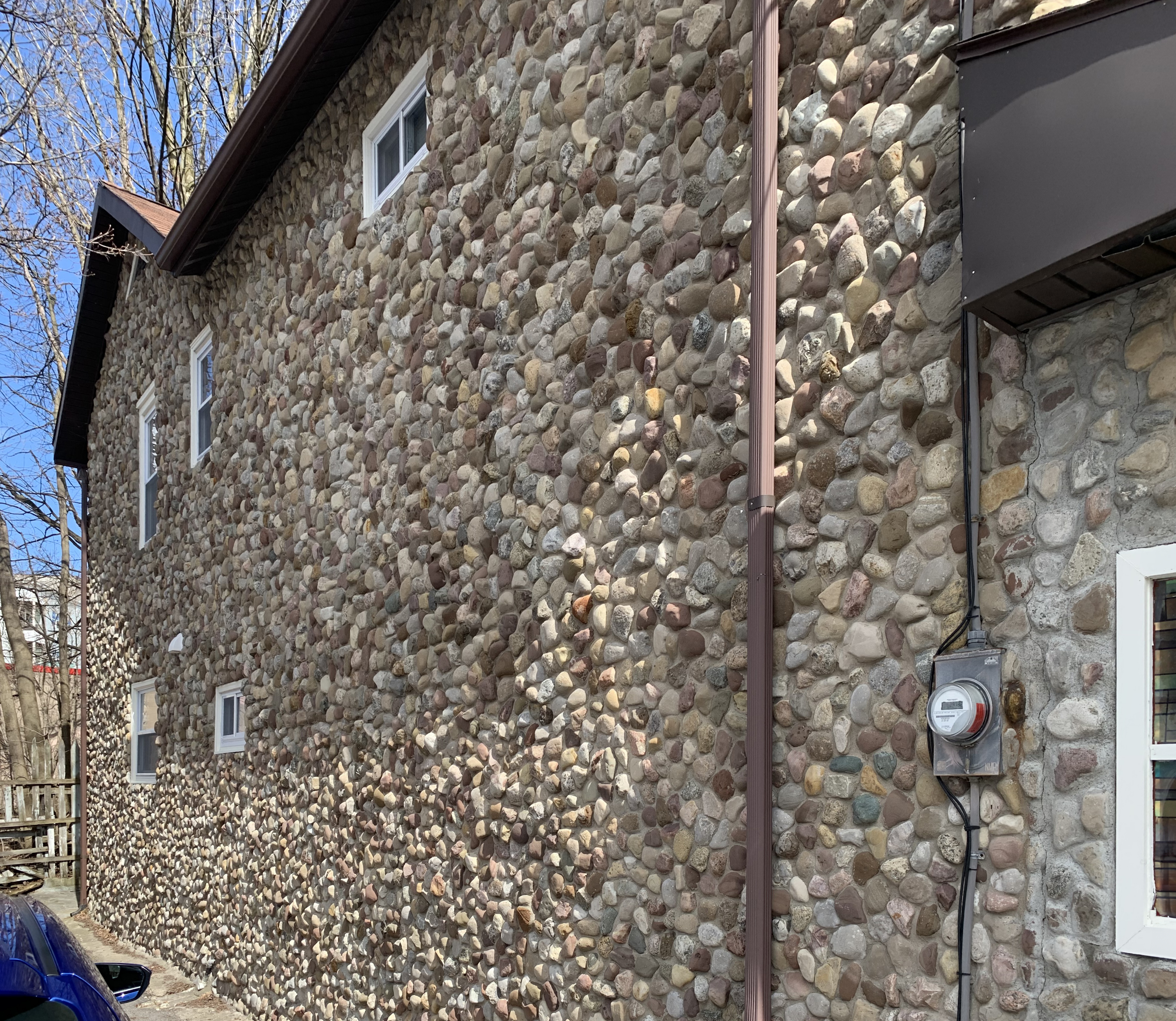 IMG_3106.jpg ¹ |
¹ Photography courtesy William Sauers.
